Subject

Mathematics

We develop mathematical thinkers through deep, structured training — building logic, creativity, and confidence from Primary all the way to Senior level. Our Olympiad approach goes far beyond the classroom syllabus.

The Mathematics pathway

Ages 13–16 · Years 9–11

Deepening rigour and competition readiness

Intermediate students tackle harder competition problems and begin mastering GCSE and beyond. We focus on building the depth and speed needed for timed Olympiads while still covering the full curriculum with excellence.

What we cover

  • Advanced algebra and inequalities
  • Number theory: primes, GCD/LCM, remainders
  • Combinatorics and graph theory
  • Circle theorems and trigonometry
  • AM-GM and classical inequalities
  • GCSE exam strategy

Competitions & exams we prepare for in United Kingdom

  • Intermediate Mathematical Challenge — IMC (UK)
  • Grey / Pink Kangaroo (UK)
  • Cayley / Hamilton / Maclaurin Olympiads (UK)

Topics we explore

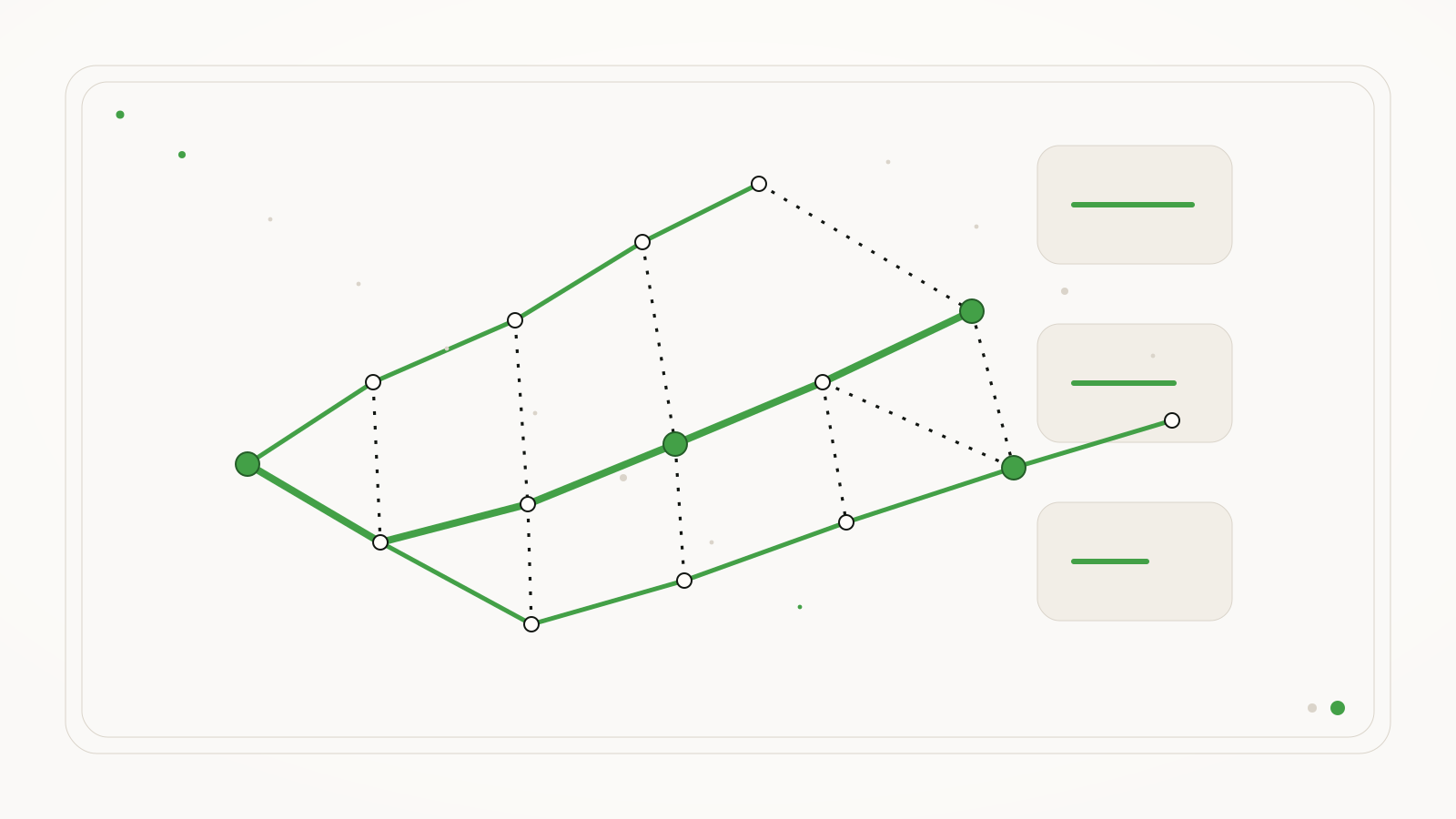
ProductivityView on ProblemsFixed Point of a SimilarityInteractive geometry demo: scale, rotate, and drag a shape to see the invariant point appear, then try the guess-the-point challenge mode.View on ProblemsChallenging Triangle CongruenceMost students are already familiar with the three standard triangle congruence rules taught in school: SSS (Side-Side-Side), SAS (Side-Angle-Side), and ASA (Angle-Side-Angle). These form the foundation of geometry and are commonly seen in classroom exercises and exams, including the GCSE Mathematics syllabus.But what happens when we encounter problems that don’t follow these standard patterns directly? Can we still prove triangle congruence using medians, altitudes, angle bisectors, or partial side information?In this section, we explore a selection of challenging triangle congruence problems that require deeper reasoning and clever constructions. These problems go beyond the textbook basics and are perfect for students preparing for Olympiad-style questions, GCSE extensions, or anyone wanting to sharpen their proof skills.View on ProblemsCircumcircle of a TrianglePractice problems on circumcircles of triangles: centers, angles, chords, and construction. Ideal for Olympiad geometry and advanced learners.View on ProblemsInscribed QuadrilateralLearn the theory and solve challenging problems about inscribed quadrilaterals. Perfect for math Olympiad prep, this page covers trapezoids, kites, and key geometric proofs.View on ProblemsPythagoras' theoremThese problems use the Pythagoras theorem and its consequences (perpendicularity criteria, projections, and equal‑tangent loci) to prove algebraic relations and describe geometric sets.‍View on ProblemsTangentExplore key theorems about tangents to circles and solve problems involving radii, angles, and geometric constructions with tangents.View on ProblemsAxioms and Postulates of EuclidView on ProblemsMinimum and Maximum Problems in GeometryMinimum and Maximum Problems in GeometryView on ProblemsAM–GM InequalitiesThe Arithmetic–Geometric Mean Inequality:If a ≥ 0, b ≥ 0, then(a + b)/2 ≥ √(ab) ≥ b.Equality holds if and only if a = b.‍View on ProblemsBalance Scale PuzzlesClassic counterfeit-coin and balance-scale problems where each weighing splits the cases into three branches.View on ProblemsCryptarithmsWord puzzles where letters represent digits in arithmetic equations. Each letter stands for a unique digit.View on ProblemsEquations in IntegersSolve equations where the unknowns must be integers. Core techniques: factoring into integer divisor pairs, parity arguments, modular obstructions, and difference-of-squares decompositions.View on ProblemsGame Theory & StrategiesIn competitive games, the best outcome depends not only on your own decisions but also on the choices made by others. Strategic thinking helps you find optimal moves.View on ProblemsGCD and LCMIn this lesson, we will work with the concepts of the greatest common divisor (GCD) and least common multiple (LCM), as well as related problem-solving techniques. The GCD of two numbers is the largest number that divides both of them without a remainder. The LCM of two numbers is the smallest number that is a multiple of both.View on ProblemsKnight's TourA chess knight must visit every square exactly once. Explore tours on 5x5 to 8x8 boards and the graph-theory ideas behind them.View on ProblemsMathematics in ChessAn overview of chessboard problems about parity, move graphs, extremal placements, exact-opponent attacks, and Knight's Tour, with focused guides below.View on ProblemsNumber TheoryView on ProblemsOther Chessboard ProblemsA pair of chessboard construction problems driven by row-column counts and Hamiltonian-style reasoning on custom move graphs.View on ProblemsRemainders of Squares and CubesView on ProblemsSpot the Formula!Recognise and apply standard algebraic identities — difference of squares, square of a sum/difference, sum and difference of cubes, and Sophie Germain — to simplify expressions, prove divisibility, and evaluate products.View on ProblemsThe Principle of Mathematical InductionMathematical induction is a powerful proof technique for establishing that a statement holds for all natural numbers.View on ProblemsTriangle InequalityIn this lesson, we will use an important result known as the Triangle Inequality:|x| + |y| ≥ |x + y|View on Problems

Courses in Mathematics

Ready to start?

Start your Mathematics journey

A free 30-minute trial lesson to find the right level and set a clear path forward.

Book a free trial