
A school can sit near the top of a medal table and still tell you surprisingly little about how it teaches mathematics. Here is how I would read the PMC Bonus Round 2026 results if I were a parent choosing carefully.
A school can sit near the top of a medal table and still tell you surprisingly little about how it teaches mathematics.
That is the mistake parents make all the time.
They see a big number, assume strong provision, and move on.
I would be more careful than that.
In November 2025, more than 61,000 pupils took part in the Primary Maths Challenge main round. 3,100 of those pupils, scoring 21 marks or higher, were invited to the Bonus Round in February 2026. From the scripts returned, 85 pupils achieved full marks.
Those numbers matter. But the more useful question is different.
What do these results actually tell a parent?
The official results and award boundaries are published on the PMC Bonus Round page. Below, I have broken the data into three more useful views: total medals, gold medals, and gold share.
Why the headline medal table is only a starting point
The first table is the one most people look at. Total medals. Gold, silver, bronze added together.
It is useful. Just not sufficient.
Schools with larger cohorts, strong entry rates, and established preparation routines will usually rise quickly in this kind of ranking. That does not make the result meaningless. It does mean we should avoid treating it as a pure measure of mathematical depth.
| Award | Score |
|---|---|
| Gold | 24 - 25 |
| Silver | 21 - 23 |
| Bronze | 18 - 20 |
Pupils who scored 18 or above appear in the official Award Winners list.
Top schools by total medals
These schools recorded the highest number of Bonus Round medals in 2026.
| Rank | School | Gold | Silver | Bronze | Total |
|---|---|---|---|---|---|
| 1 | St Paul's Juniors | 17 | 27 | 25 | 69 |
| 2 | Westminster Under School | 6 | 21 | 20 | 47 |
| 3 | Bute House Preparatory School | 0 | 24 | 20 | 44 |
| 4 | City Junior School | 2 | 19 | 15 | 36 |
| 5 | King's College School Wimbledon | 5 | 12 | 17 | 34 |
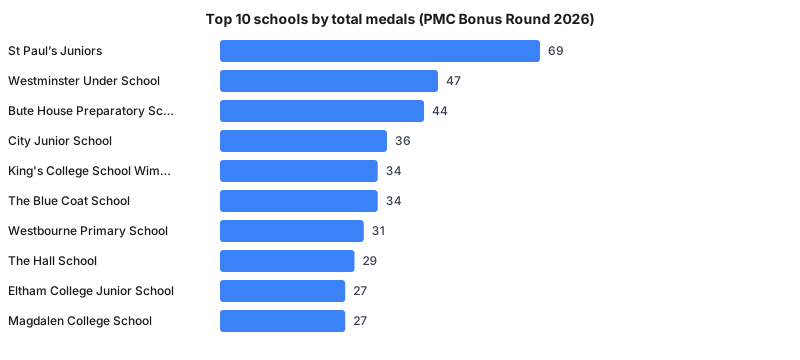
St Paul's Juniors leads by a distance, with 69 medals and 17 golds. Westminster Under School also shows both volume and quality. Bute House Prep is interesting for a different reason: 44 medals, but no golds. That usually points to a strong cohort with a ceiling it has not quite broken through yet.
This is exactly why I do not like total-medal tables used on their own. They mix together two different things:
- scale of participation
- depth of top-end performance
Those are related. They are not the same.
What gold medals tell you that bronze and silver do not
If I want a quick signal for top-tier problem-solving, I look at golds.
Not because silver and bronze are weak results. They are not. But gold usually tells you that more pupils are handling the hardest part of the paper, not merely staying competitive across the middle.
| Rank | School | Gold | Silver | Bronze | Total |
|---|---|---|---|---|---|
| 1 | St Paul's Juniors | 17 | 27 | 25 | 69 |
| 2 | Westbourne Primary School | 7 | 12 | 12 | 31 |
| 3 | Westminster Under School | 6 | 21 | 20 | 47 |
| 4 | The Hall School | 6 | 12 | 11 | 29 |
| 5 | Kew Green Prep School | 6 | 11 | 1 | 18 |
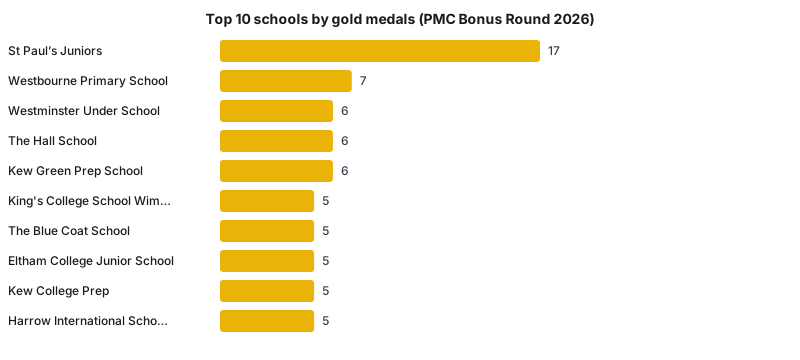
Two schools jump out immediately.
Westbourne Primary School and Kew Green Prep School both post gold counts that are stronger than many larger schools. Kew Green is especially striking: 6 golds from 18 medals, with only 1 bronze. That is not just broad participation. That is concentration at the top.
This is where parents should slow down and ask a better question:
Is the school producing a lot of entries, or is it producing strong mathematical thinkers?
The ideal, obviously, is both. But if you cannot have both, I would rather know which one I am looking at.
The most revealing table is often gold share
Here is the view I find most underrated.
Gold share asks a simpler question: of the pupils from a school who won medals, how many reached gold?
It is not perfect. Small sample sizes can distort it. But it often reveals schools where challenge maths is taken seriously rather than treated as an occasional enrichment add-on.
We looked at schools with at least 3 medals and ranked them by gold as a share of total medals.
| School | Gold | Silver | Bronze | Total | Gold share |
|---|---|---|---|---|---|
| Crabtree Junior School | 2 | 1 | 0 | 3 | 67% |
| Rush Common School | 2 | 0 | 1 | 3 | 67% |
| Winnersh Primary School | 2 | 1 | 0 | 3 | 67% |
| Cawston Grange Primary School | 5 | 3 | 0 | 8 | 63% |
| Pinnacle Global Academy | 3 | 2 | 2 | 7 | 43% |
| City Of London Freemen's School | 2 | 2 | 1 | 5 | 40% |
| Royal Grammar School Dubai | 2 | 0 | 3 | 5 | 40% |
| Harrow International School Hong Kong | 5 | 2 | 6 | 13 | 38% |
| Newton Prep School | 3 | 3 | 2 | 8 | 38% |
| Kew Green Prep School | 6 | 11 | 1 | 18 | 33% |
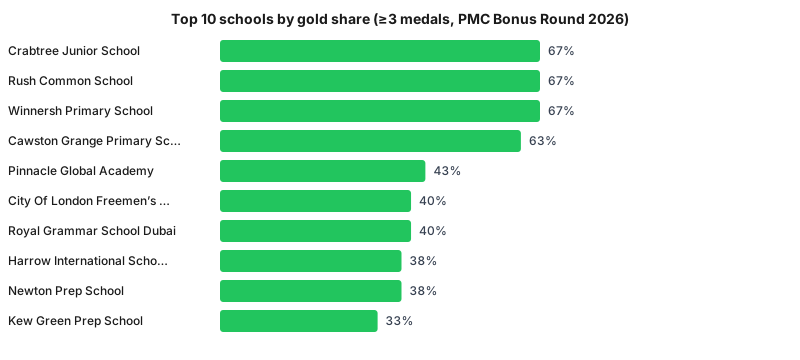
Schools such as Crabtree Junior School, Rush Common School, Winnersh Primary School, and Cawston Grange Primary School stand out here. They are not dominating by raw medal count. They are doing something else.
They appear to be converting a high proportion of successful entrants into top-tier performers.
For me, that is often the more interesting signal.
The mistake parents make when reading school competition results
Parents often use competition tables the way they use league tables: find the highest number and assume that is the safest choice.
I think that is too crude.
A representative example. A parent compares two schools. One has a much bigger medal total, so they assume the maths provision must be stronger. Then we look more closely. The second school has fewer entries, more golds relative to cohort size, and pupils who are clearly comfortable with non-routine problems. Suddenly the picture changes.
That happens because competition maths is not just curriculum maths done faster.
It depends on habits that are easy to miss from the outside:
- whether pupils are taught to persist when the route is unclear
- whether they are exposed to genuinely non-routine questions
- whether mistakes are diagnosed properly instead of covered up with more worksheets
- whether the strongest pupils are stretched early enough
Those things do not show up cleanly in a single medal count.
My view: care less about volume, more about mathematical culture
I think many schools still misunderstand competition maths. They treat it as an optional extra for bright children, rather than as a training ground for deep mathematical thinking.
That is backwards.
The value of Olympiad-style work is not only the medal. It is the kind of mind it builds: patience, structure, flexibility, and comfort with unfamiliar problems.
So if I were reading these results as a parent, I would not ask only which school won the most medals. I would also ask which school seems to produce real top-end problem-solvers, and which school is likely to stretch a mathematically ambitious child rather than merely keep them busy.
That is a better filter.
What parents should take away
- St Paul's Juniors leads convincingly on total medals and gold medals.
- Westbourne Primary School and Kew Green Prep School look particularly strong when you focus on golds.
- Crabtree Junior School, Rush Common School, Winnersh Primary School, and Cawston Grange Primary School stand out on gold share.
- Total medals are informative, but not decisive. They should start the conversation, not end it.
If your child is preparing for the PMC or similar competitions, focus on deliberate problem-solving rather than doing more questions blindly. Start with past papers. Review mistakes properly. Pay close attention to the questions where the method is not obvious immediately.
You can find past papers and interactive problems on problems.cc. For competition dates and the wider challenge-maths pathway, olympiads.co.uk is a useful second step.
This article uses the official PMC Bonus Round 2026 results, aggregated by school. Award boundaries and full winner lists are published by the Primary Mathematics Challenge.