
How trials, independent problem-solving and teacher judgement help us recommend a group where your child can think, contribute and progress.
Age gives us context. It does not decide the group.
Two students in Year 7 can need very different maths lessons.
I already teach a Year 7 student tackling Senior Maths Challenge material. Another student in the same school year may be developing much earlier problem-solving skills. Putting them together simply because they are the same age would tell us very little about whether the lesson would work for either of them.
Age still matters. So do school experience, confidence and the way a student participates. But for competition and problem-solving maths, we need to see what they can actually do.
Our aim is to recommend a group where the problems stretch your child, they can contribute to the discussion, and the students are ready to make progress together.
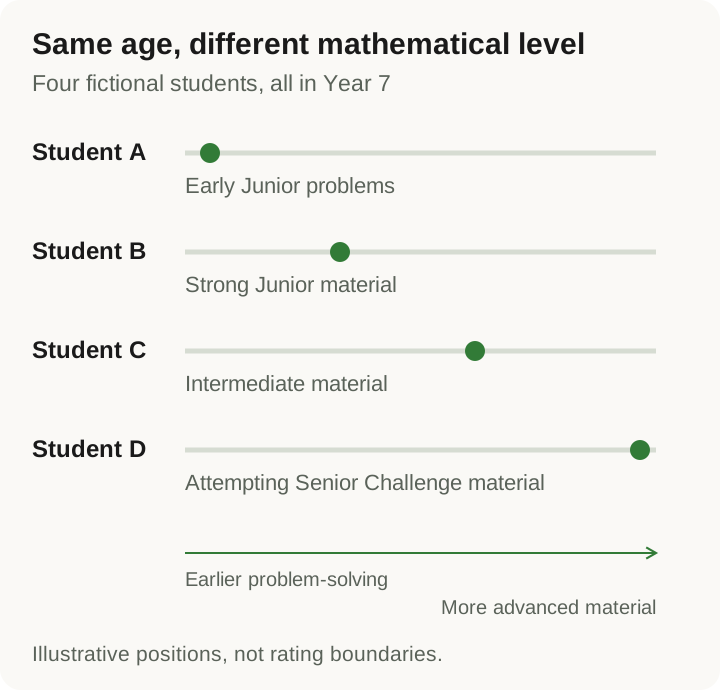
Same school year, different starting points. Competition labels describe example material here, not fixed ability bands.
Start with a free trial lesson
A free trial gives us a chance to work with your child before recommending a group.
We look at which problems they can approach independently, how they explain their thinking, and what happens when the first approach does not work. We also notice when a hint helps, how confidently they participate, and how much time they need to make progress.
Getting an answer right is useful evidence. It is not the whole assessment.
A student might recognise a familiar problem and finish it quickly. Another might take longer with an unfamiliar question, but explain a promising line of reasoning and respond thoughtfully to a small hint. We want to understand both.
Speed helps us judge whether the group's pace is likely to suit them. We do not treat it as a race or assume that the quickest answer shows the strongest understanding.
What we are looking for is where productive difficulty begins: the point at which a student has to think, but still has enough knowledge to get somewhere.
Independent problem-solving adds more evidence
Your child can also create an account on problems.cc and solve problems in their own time before joining a group.
Relevant activity gives us a wider view than a single lesson can. We can look at the problems they attempted, what they solved, the material they have encountered and where difficulties appeared.
There is no need to build a long practice history before booking a trial. If we have little independent activity to work from, we start with the trial and the information you share with us.
As that history grows, it can help us make a more informed recommendation.
Maths Rating is a guide, not a verdict
Maths Rating gives us an approximate quantitative indication of a student's current level from their activity on problems.cc.
It is one input into placement. We do not use a rating as an absolute measure of mathematical ability, or assume that everyone with a similar number belongs in the same group.
The problems behind the rating matter too.
Two students may have similar overall ratings while having very different experience of geometry, number theory or combinatorics. One may have practised a particular competition extensively. Another may be meeting that style of problem for the first time.
We look at that history alongside what we observe in the trial. The teacher makes the recommendation.
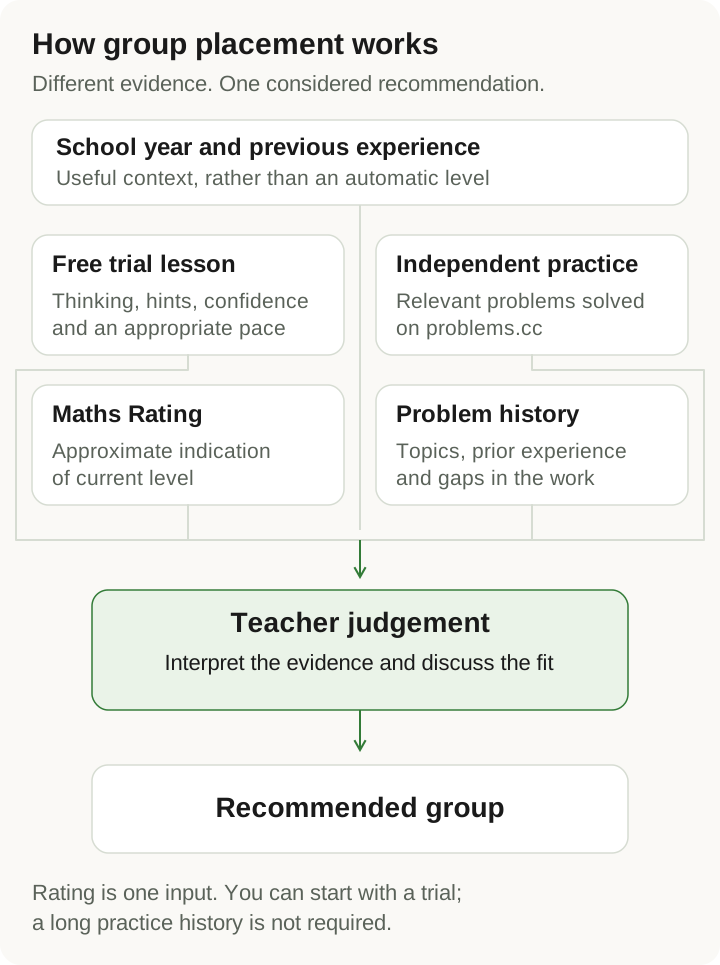
We are looking for a workable shared level
The right group is not simply the hardest group a student can survive.
If almost every problem is inaccessible, it becomes difficult to contribute. If most of the work is already familiar, there may be too little new thinking to justify the lesson.
We want a student to encounter genuine challenge while still being able to attempt problems, explain an idea, learn from another student's approach and respond to the teacher's questions.
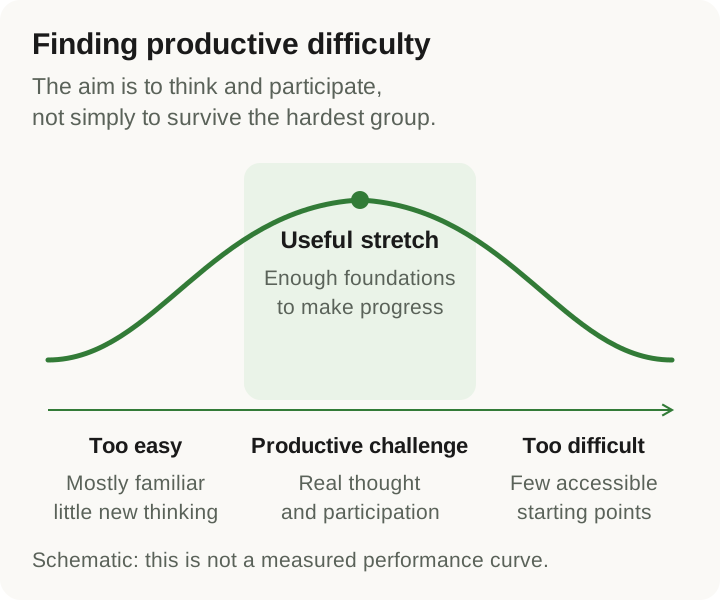
In practical terms, we are looking for four things:
- Problems that require real thought.
- Enough shared foundations for your child to participate confidently.
- Other students working at a sufficiently similar overall level.
- A pace and direction the group can sustain together.
That does not require identical knowledge. How we handle different topic histories within a suitable group is the subject of our companion article, how we keep group maths lessons personalised.
Placement can change
A recommendation is a starting point, not a permanent label.
Students develop at different rates. Lessons may reveal strengths or gaps that were not apparent in the trial. If the work consistently becomes too familiar or too difficult, we should review the fit and discuss whether another group would be more appropriate.
Any move depends on a suitable group being available. We would rather explain that clearly than recommend a poor fit simply because a slot is open.
The question is always whether this group is useful for this student now.
Unsure where to start?
Book a free trial lesson, or create an account on problems.cc and start solving problems. We can use the trial, relevant activity and your child's previous experience to help recommend a suitable group.