About five recommended problems
whether or not there is separate homework.
Built by Exact Science
Students work through problems chosen for their level and recent topics. The platform records what they actually solved, so you can see the work and the next lesson can start from it.
Practice hub & training plan
How it supports lessons
whether or not there is separate homework.
to keep practice at the right level and to place similar students together.
as well as the short daily set.
showing what was solved, and when.
Topics, language, and contest preparation can be adapted for different countries while keeping the same training structure.
How it works
Problems.cc is where students practise between lessons. The lesson stays with the teacher. The platform keeps a record of what they solved and suggests what to try next.
Practice is the standing work: a short set of problems chosen for their level. The teacher may also name extra work in the lesson, such as finishing a library chapter or part of a past paper. If that extra work is not said in the lesson, it is not set.
Level and groups
Maths Rating is an estimate of the student's current level. We use it to choose problems that sit close to that level, so the work stays balanced.
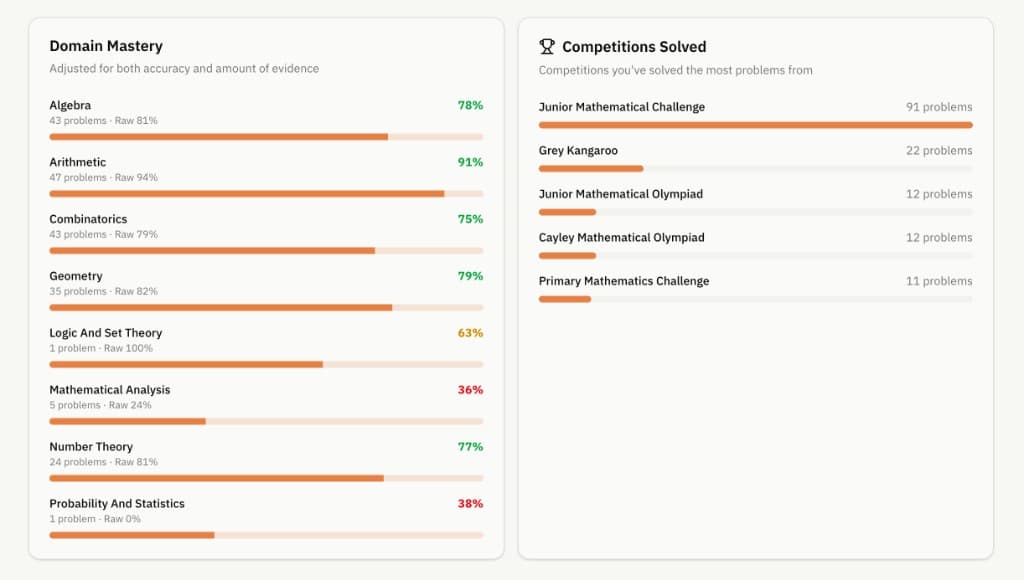
The profile also shows a picture by topic, such as algebra, geometry, and number theory. Together, the rating and that picture help us place students of a similar level in the same group. The teacher still decides the placement.
Daily practice
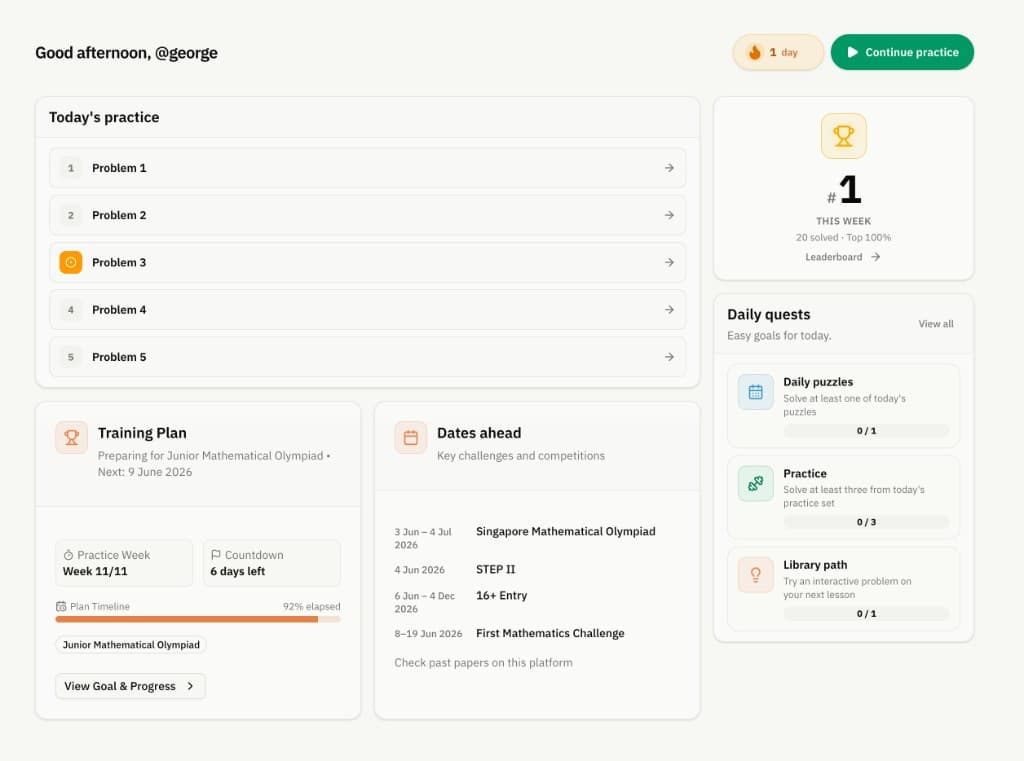
After they log in, Practice shows about five recommended problems, chosen from their level and the topics they have been working on. The daily quest is to complete at least three of those five.
They can practise on different days during the week, or solve more on one day. Missing a day does not leave a pile of old worksheets. The screen shows a current set, and that set changes as they solve.
Past papers
Past papers are the actual contest papers: Junior Mathematical Challenge, Grey Kangaroo, and many others. Most of the daily practice problems come from this material.
A student who wants a full paper can open it and work through it. That is also where the teacher may send them if extra work was named after a lesson.
Library and games
The library is a set of chapters around a mathematical idea. Each chapter introduces the idea, then connects it to related problems. This is useful when a topic is new, or when the teacher asks them to finish a chapter after the lesson.
Daily puzzles such as Cryptarithm, Magic Square, and Summit are a short extra. They sit beside the weekly practice, as a lighter way to keep a habit going.
What you can check
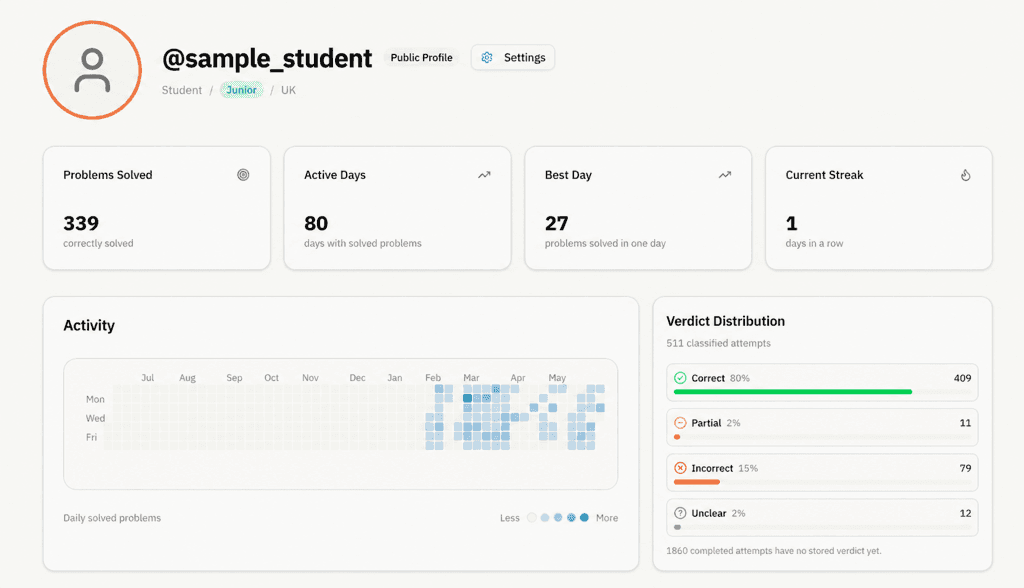
A parent can open the student's profile and see days they worked, problems completed, streaks, and an overall split of correct, partial, and incorrect. There is often a timeline of what they finished, such as a past-paper question or a daily game.
Opening a problem shows the question. It does not show the answer they submitted, and it does not show a mark such as 85 out of 100. These are mostly Maths Challenge and Olympiad-style problems, so we care about the level and type of problems they can solve, and where they stall.
The teacher can see more of that history when preparing the next lesson.