
How previous problems, topic experience and lesson observations shape what a group studies next, within a structured mathematical programme.
A suitable group is the beginning
Individual lessons can respond closely to one student. A reasonable concern about joining a group is that the teaching becomes a fixed programme: everyone gets the same material, whether they already know it or are missing the foundations.
When I started building our group lessons, this was one of the things I most wanted to avoid.
Placing students at a compatible overall level helps. But it does not tell us everything they have studied or what the group should do next.
Three students can be ready for a similar level of challenge while bringing different mathematical histories into the room.
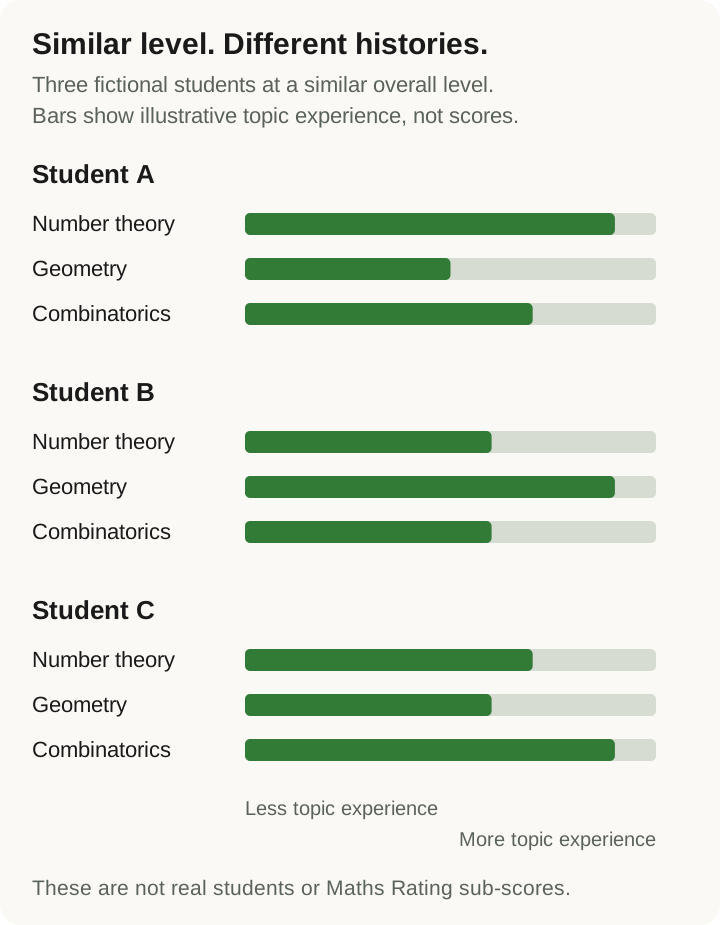
Start with what students have already done
Through problems.cc and our teaching records, we are building a clearer picture of each student's mathematical experience.
Depending on the activity and records available, we can draw on:
- Problems they have attempted and solved.
- Mistakes that appeared in their work.
- Topics and library chapters they have worked through.
- Competition material they have already encountered.
- Strengths and gaps suggested by their activity and lesson discussions.
That picture is still developing. We do not have a complete record of every problem a student has seen elsewhere, and a correct answer alone does not tell us how securely they understand an idea. The teacher still needs to ask questions and watch how they work.
Even an incomplete history can improve a decision. If a student has already solved a problem comfortably, we should know why we are choosing to revisit it. There may be a good reason: finding another solution, explaining a proof or connecting it to a new idea. Unintentional repetition is much less useful.
The same applies to a whole group. If they already understand a technique, there is little reason to spend several weeks on it simply because it comes next in a preset sequence.
A topic can have many routes through it
Our problem library is organised into mathematical topics and chapters. Those topics intersect, and the same idea can appear in different competitions, years and problem styles.
Divisibility, for example, might involve recognising a useful rule, reasoning about remainders or explaining why a rule works. Those are connected ideas, but they do not all demand the same level of understanding.
A chapter therefore gives us more possibilities than one worksheet with ten questions in a fixed order.
A useful analogy is making a playlist. The theme is shared, but the selection and order can change for the people taking part.
For a group lesson on divisibility, we might choose a short problem to check the foundations, a less familiar application, a question from a competition and an extension that asks for a deeper explanation. That is an illustrative sequence, not a promise that every lesson follows those four steps.
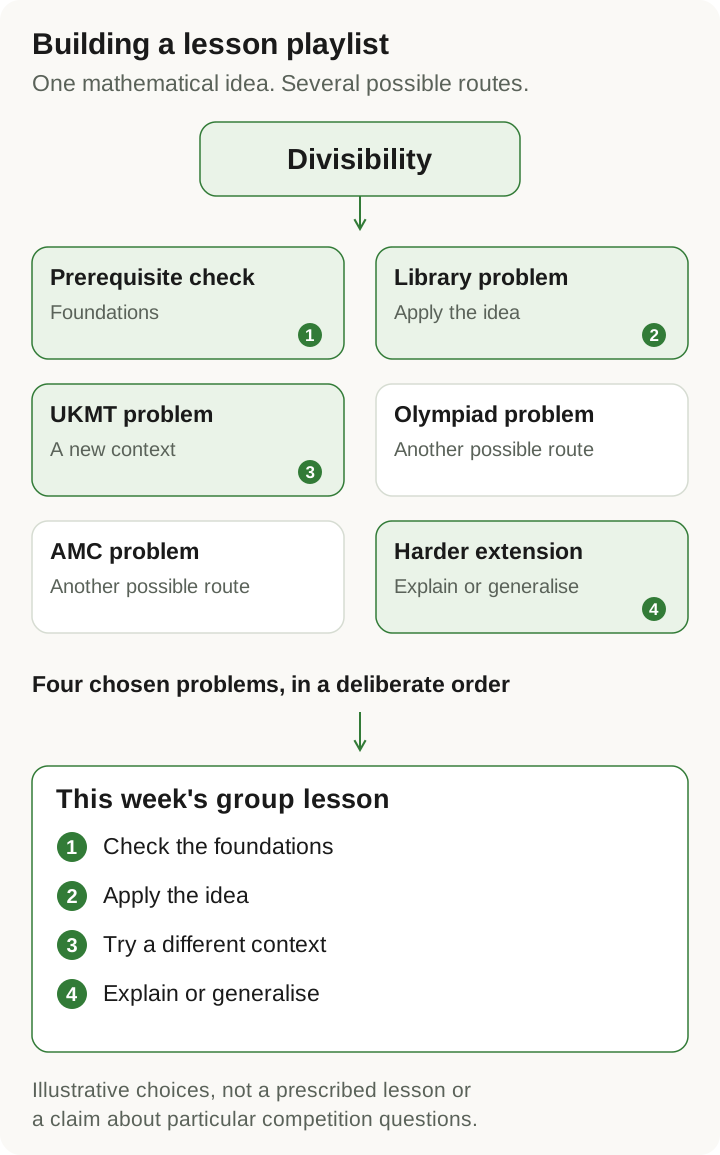
When planning, we try to select problems that students have not already solved, fit the group's level, build on one another and reveal different aspects of the same idea. Different competition sources and contexts can help us test whether students recognise the underlying mathematics beyond one familiar question style.
The teacher chooses the sequence. The library makes more routes available.
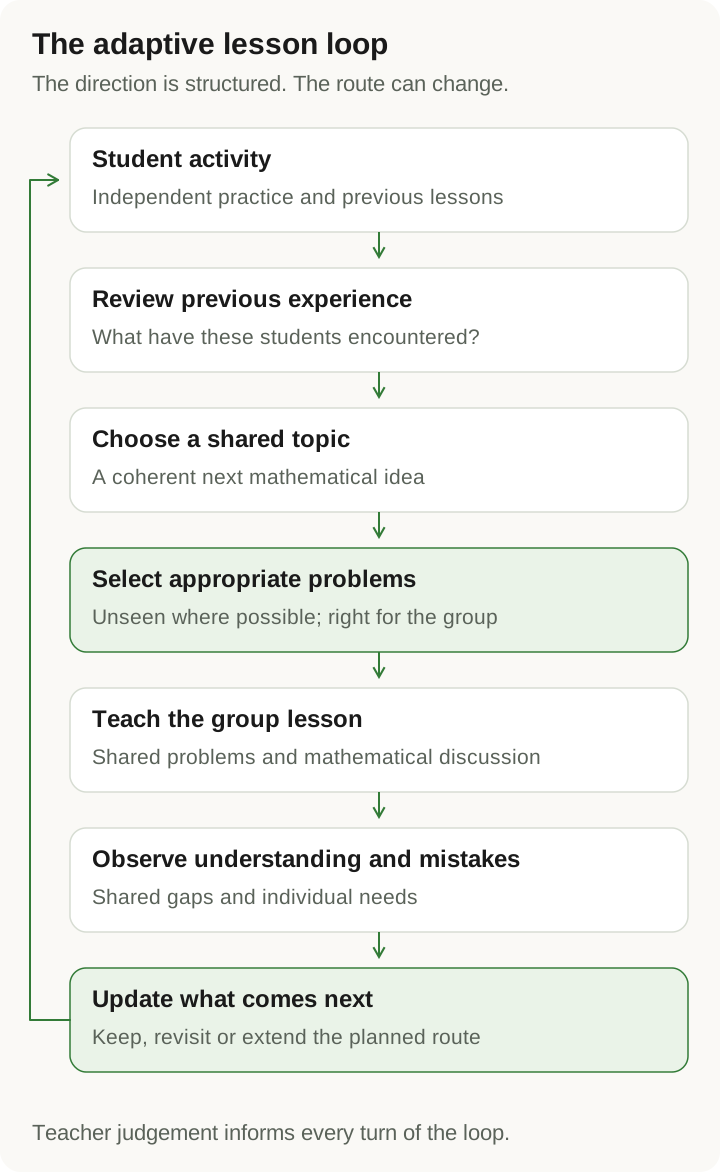
The direction is structured. The route can change.
Responding to students does not mean choosing unrelated problems from week to week.
There should still be mathematical progression: foundations before extensions, ideas revisited in more demanding forms, and a clear reason for what follows what.
What can change is the route through that structure.
If several students make the same mistake, the next lesson may need to address it before moving further. If the group understands an idea securely, we can choose a more demanding application. If one student has a particular gap, we can identify it without assuming that everyone needs to repeat the whole topic.
The lesson itself gives us information that independent practice cannot: how students explain an argument, respond to another solution, use a hint and recognise that an approach has failed.
We want that information to influence the next teaching decision.
A shared lesson, with attention to individual gaps
Personalisation in a group does not mean that each student receives a separate lesson at the same time.
The students explore the same mathematical ideas together. They work on shared problems, compare approaches and learn from the discussion. We choose that shared work with the group's readiness and previous activity in mind.
Individual differences still need attention. A gap may call for a precise hint, a follow-up problem or separate work on a prerequisite. If a student's needs consistently sit outside what the group can usefully study together, that is also a reason to review their placement.
The aim is a useful shared lesson in which individual needs are visible and can be addressed, rather than assumed away.
A clearer history should lead to better decisions
As students use problems.cc and our teaching records develop, we should have richer evidence about what they have encountered and what would be useful next.
That is the direction we are building towards. More recorded activity does not automatically produce better teaching, and it does not remove the teacher's responsibility to decide what is appropriate.
It should make those decisions easier to explain and better informed.
If you are considering a group, you can browse the current timetable or book a free trial to help us understand your child's starting point.
For every lesson, we want to be able to answer:
What do these students already know, and why are we choosing these problems next?