Knowing circle theorems is only the beginning. BMO geometry asks students to recognise useful relationships and turn them into proofs. Here is the learning order I recommend.
A student knows the circle theorems, can use the cosine rule and gets strong marks in school geometry. Then a British Mathematical Olympiad problem asks them to prove that three lines meet at one point, and they have no clear starting point.
The missing skill is often choosing which relationship to prove first. Another theorem on a revision sheet will not necessarily fix it.
For a first BMO1, I would build dependable angle reasoning, congruence, similarity, circle geometry and area methods, then learn how to combine them. More advanced tools become useful as the problems demand them. There is no need to collect every named theorem before attempting a proper geometry proof.
We have organised a wider learning pathway at geometry.problems.cc/library. This article explains how I would choose a route through it for BMO preparation.
Begin with the job the problem is asking you to do
The useful preparation question is: can the student turn the target into something they know how to establish?
“Find this angle” and “prove these four points lie on a circle” may use the same angle facts, but they ask the student to organise those facts differently.
Before calculating, write down the target:
- equal lengths might follow from congruent triangles, equal tangents or a symmetry;
- a ratio might come from similar triangles or comparing areas;
- four concyclic points might be established through equal angles or opposite angles summing to ;
- concurrent lines might call for a triangle-centre property or a ratio argument.
These are possible routes to investigate. The diagram and the hypotheses decide whether they work.
The foundations I would make reliable first
Angle reasoning and congruence
Be comfortable with parallel lines, triangle angle sums, exterior angles, isosceles triangles and the standard congruence criteria. The real test is using several of them in sequence without quietly assuming something from the picture.
When claiming two triangles are congruent, name them in corresponding order and give the criterion. A diagram that looks symmetrical does not establish a symmetry.
In the library, Axioms, angles and geometric proof and Triangle congruence and auxiliary constructions are useful places to strengthen that reasoning.
Similarity and area ratios
Similarity lets you transfer information between parts of a figure. It is especially useful when parallel lines, repeated angles or intersecting chords create triangles of the same shape.
Keep the correspondence clear. If the scale factor for lengths is , the scale factor for areas is .
Area comparisons are just as valuable. Triangles on the same base and between the same parallels have equal areas. Triangles sharing an altitude have areas in the ratio of their bases. Those observations can turn an awkward length ratio into a short argument.
Start with Similar triangles and proportional segments, then revisit a past problem where you could not see how to compare two lengths.
Circles, tangents and cyclic quadrilaterals
Know the standard circle theorems and their conditions. Practise using their converses as well: equal angles may be evidence that a circle should be introduced, even when no circle appears in the original diagram.
The core tools include angles subtended by a chord, angles in a semicircle, cyclic quadrilaterals, the tangent-chord theorem and equal tangents from a point.
As you extend this, learn power of a point. Understand which segments occur in the product and why the identity follows, rather than memorising a picture with letters attached.
Learn to introduce the missing circle
Consider an acute triangle . Let be the foot of the perpendicular from to , and let be the foot of the perpendicular from to .
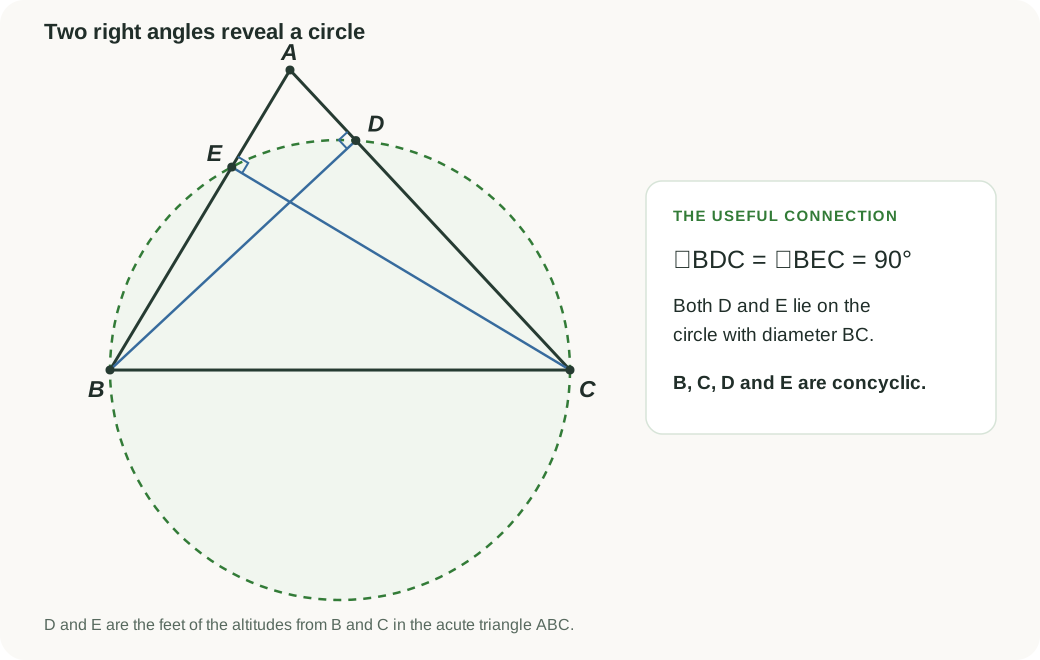
We know that
Therefore and both lie on the circle with diameter . Four points that initially belonged to two different right triangles now belong to one cyclic quadrilateral.
This is a deliberately small example. It shows the sort of connection a student must learn to make: two right angles can suggest a circle, and the circle gives access to further angle relationships.
A representative practice mistake is to calculate every visible angle without asking what would help. A better attempt begins with the target, looks for a useful relationship and only then does the calculation. The difference is visible in the written argument: each new fact has a purpose.
Extend the toolkit when there is a reason to
Once the foundations work, these are worthwhile next steps. This is my teaching order, not an official BMO syllabus or a guarantee about any particular paper.
| Tool | What it helps you investigate |
|---|---|
| Angle-bisector theorem | Ratios created where a bisector meets the opposite side. |
| Triangle centres | Relationships involving medians, altitudes, angle bisectors and perpendicular bisectors. |
| Ceva's theorem | Whether three lines through a triangle's vertices meet at one point, using ratios on the opposite sides. |
| Menelaus' theorem | Whether three points on the sides or their extensions lie on one line. |
| Power of a point | Length products coming from secants, chords and tangents. |
| Reflection, rotation and homothety | Moving or scaling a configuration to expose an equality, ratio or simpler comparison. |
| Sine rule, cosine rule and coordinates | Turning a suitable configuration into manageable algebra. |
The library has connected chapters on medians and midlines, the circumcentre, the centroid and the incentre. Choose according to the gap in your attempts, even if the chapter's level label is below your school year.
For stronger students moving towards BMO2 and further Olympiad work, radical axes, spiral similarity, inversion and complex-number methods can become useful. I would introduce them when a student has enough control of simpler configurations to understand what the new method buys them.
Coordinates are a perfectly reasonable choice when they simplify the proof. Before introducing them, choose axes that use the given structure and estimate how much algebra the target will require. The same judgement applies to a synthetic construction.
Use the geometry library to repair a specific gap
geometry.problems.cc/library brings connected geometry chapters and problem collections together, from earlier foundations to advanced ideas. It is a wider curriculum, so a BMO student should choose a route through it rather than try to finish everything before their next paper.
The distinction between a chapter and a competition question is useful. A chapter isolates an idea. A BMO problem asks you to decide which ideas to combine.
I would use the library in this order:
- Attempt a geometry problem first. Write down where your argument stops.
- Choose the relevant chapter. A missing length ratio may point to similarity; a circle that you failed to recognise may point to cyclic quadrilaterals.
- Explain the theorem and its conditions. Be able to state precisely why it applies to your diagram.
- Solve a few related problems. Redraw the figures and justify the steps, including any added lines or circles.
- Return to an unfamiliar past problem. Test whether you can choose the tool without a chapter heading telling you what to use.
For competition practice, use the BMO1 archive on problems.cc, with the BMO2 archive as a further step. Some recurring BMO topics and methods have already been collected into practice sets on the BMO1 page. The geometry library supplies a more sustained route through the geometric ideas themselves.
When reviewing your written attempt on problems.cc, ask the AI assistant to identify the first angle equality, similarity claim or construction that you have not justified. Explain your repair, then try a related problem without help. Check the feedback against a reliable solution or teacher: an AI assessment is practice feedback, not an official BMO mark.
An optional supporting book
If you want a book alongside the online practice, Plane Euclidean Geometry: Theory and Problems by A. D. Gardiner and C. J. Bradley develops Euclidean geometry through theory and problems. Choose chapters around the gap you are working on; you can begin with the library and past problems.
For the wider practice cycle, AI feedback and a dated three-week plan before BMO1 2026, see How to prepare for the British Mathematical Olympiad.
Geometry in continued Olympiad preparation
We are planning a small-group Olympiad problem-solving course, with geometry included alongside algebra, number theory and combinatorics.
The geometry work will focus on angle reasoning, circles, similarity, area ratios and choosing useful constructions. Students will write proofs and receive feedback on the reasoning, so we can distinguish a missing theorem from a missing connection. More advanced extensions will depend on the group's starting point.
The official calendar places BMO1 on 18 November 2026 and BMO2 on 20 January 2027. For this year's BMO1 students, the immediate focus is the remaining preparation time. Lessons continuing after the November paper develop proof-writing for future challenges, including BMO2 where appropriate. Entry to BMO2 follows UKMT's qualification or discretionary-entry rules.
Course dates, times and booking details will be shared through our timetable. If a suitable BMO group is not listed yet, use Help me choose and tell us about the student's experience and competition plans.
Meanwhile, take one geometry problem you could not finish and identify the first relationship you needed but could not prove. Use the geometry library to work on that relationship, then come back and complete the argument.