
The 2026 Senior Mathematical Challenge is on Wednesday 7 October. If you are starting in late August, here is a focused six-week block that improves competition behaviour without pretending cramming can replace long-term maths.
The 2026 Senior Mathematical Challenge takes place on Wednesday 7 October. If you are starting preparation in late August, there is enough time for a focused six-week block without turning every evening into SMC practice.
That is the point of this article. Not “what is the SMC?” in the abstract. The competition is approaching. Here is what a student can productively do before it.
Date, format, and follow-on rounds are tracked on the Senior Mathematical Challenge event page. Use that for updates. UKMT is the primary source for the paper itself.
What is new in 2026
The paper is still 90 minutes. Calculators and measuring instruments are still forbidden.
The structure is changing:
- 22 multiple-choice questions
- 3 questions in 000-999 format (new for 2026)
UKMT is trialling this on the final three questions. Instead of choosing from five options, students enter a three-digit answer. That change belongs in the preparation plan, not as trivia. Week 5 below is written around it.
First: find your current level
Before the six-week plan starts, sit one full SMC paper under proper conditions.
- 90 minutes
- no calculator
- no looking things up
- no pausing the clock to “just check one idea”
On problems.cc we currently have timed SMC papers from 2006 to 2023 (18 papers, 450 problems). Use one of those. Treat 2024 and 2025 as unavailable on the platform until they are uploaded. The older papers still diagnose the same habits: accuracy under time, idea recognition, and when to leave a question alone.
The score matters less than where the marks were lost. After the paper, classify each miss:
- mathematical gap (you did not know the underlying idea)
- did not see the idea (the tools were there; the route was not)
- careless execution (right idea, wrong arithmetic or transcription)
- spent too long (the question was solvable, but not at that price)
- guessed
- abandoned something solvable
Those categories decide the next six weeks. Volume without that diagnosis mostly produces more of the same mistakes.
Week 1: diagnose and build accuracy
Protect the marks that should already be reliable.
For most students, that means the early and middle stretch of the paper. UKMT arranges questions in approximate order of difficulty. You are not expected to finish everything. You are expected to bank what you can do cleanly.
This week is not about chasing question 25. It is about:
- reviewing every error from the diagnostic paper
- separating knowledge gaps from competition technique
- rebuilding confidence on questions you should not be dropping
A knowledge gap needs teaching or a short topic burst. A technique error needs slower checking, better diagrams, or a decision rule about when to move on. Mixing those two up is how students “practise” for a month and barely move.
Week 2: strengthen weak areas with targeted sets
Sitting another full paper too soon is a common mistake. The second paper mostly re-diagnoses the same weaknesses.
A better loop looks like this:
diagnose → targeted practice → timed test
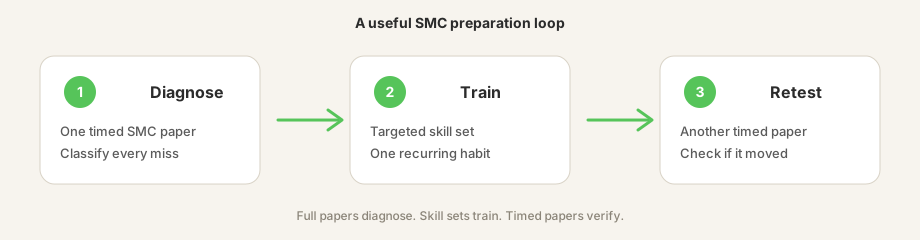
On problems.cc we have started building skill collections from the SMC archive: curated groups of past-paper problems that share a technique, so a student can train one habit without sitting a whole paper again.
We have done this more thoroughly for written olympiads. The method is the same one we described when we clustered JMO written problems into practice sets. For SMC so far, the published work is narrower: two skill sets, not a full-corpus map of every reasoning family.
| Set | Problems | What it trains |
|---|---|---|
| SMC Nested Fractions & Integer Constraints | 8 | Nested and continued fractions, positive-integer constraints |
| SMC Circle Geometry: Sectors, Arcs & Shaded Area | 12 | Composite circle-part figures: sectors, arcs, shaded area and perimeter |
Those are the live set titles on problems.cc.
A few notes that matter:
- The nested-fractions set is mostly SMC, with one related Lomonosov problem kept because it trains the same constraint habit.
- The circle-geometry set comes from a deliberate scan of questions 15-25 across 2006-2023: 198 problems looked at, 26 planar composite circle-measurement hits, 12 curated into the published set. Question 20 was the densest slot in that slice.
- We are not claiming six SMC clusters. We are claiming two useful skill bundles that show up often enough in the harder half to repay deliberate practice.
Ten related problems can teach more than another complete paper, because the paper keeps changing the subject every three minutes. The set keeps the pressure on one habit until it stops being fragile.
A pattern I see every autumn
A Year 12 student sits four past papers in a row. The scores wobble between high Bronze and low Silver. The review notes say “geometry weak” and “fractions messy”, then the next session is another full paper.
When we switched that student onto the circle-geometry set for a week, then a nested-fractions session, then one timed paper, the paper stopped being a surprise. The same late-paper shaded-area figure still took work. It no longer felt like a new species every time.
That is the point of Week 2. Isolate the habit. Drill it. Then return to the whole paper to see whether the diagnosis was right.
Week 3: learn to handle unfamiliar problems
SMC is not mainly a syllabus test.
School topics appear, of course. Algebra, geometry, number, counting. But the paper rewards students who can start when the route is not labelled.
Useful habits this week:
- draw the diagram properly, even when the question already has one
- try a small case before the general claim
- work backwards from the required answer form
- look for an invariant, a parity argument, or a symmetry
- estimate before calculating, to catch absurd options on multiple-choice questions
- eliminate impossible choices only when the mathematics supports it
Keep this mathematical. “Exam hacks” that skip the idea rarely survive the harder half of the paper, and they will not survive the new 000-999 questions at all.
Week 4: work on the harder half of the paper
From roughly question 15 onwards, selection matters as much as speed.
UKMT is explicit: do not expect to finish. Stronger students still need a policy:
- protect the early marks first
- choose later questions where you have a genuine start
- leave a blank rather than burning ten minutes on a dead end
If you are aiming at Gold, Senior Kangaroo, or BMO1, this is the week to practise that later stretch deliberately. Our circle-geometry set is built exactly from that region of the archive. Nested-fraction items also sit mostly in the mid-to-late paper.
You do not need a full topic histogram of every SMC question to use that insight. You need enough evidence that certain late-paper habits recur, and then enough practice on those habits to stop freezing when they appear.
Week 5: prepare for the new final-three format
This week deserves more attention than a bullet point.
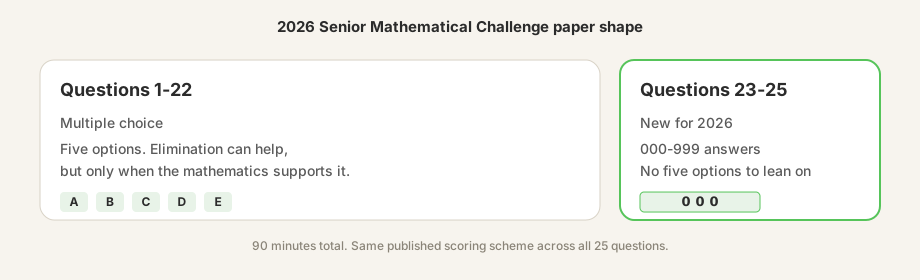
On a multiple-choice question, students often lean on elimination, option-checking, or reverse-engineering from the given answers. That scaffolding disappears when the answer is any integer from 000 to 999.
What changes in practice:
- you must derive the answer independently
- a near-miss calculation no longer “looks almost like option C”
- random guessing is worse: one wrong digit among a thousand possibilities is still wrong, and under the published mark scheme an incorrect answer costs a mark while a blank costs nothing beyond the missed +4
UKMT still scores the paper as 25 questions with the familiar scheme (start at 25, +4 correct, -1 incorrect, 0 blank). Treat blanks as a tool, not a failure.
How to train for this with the current archive:
- take late questions from 2006-2023 papers
- cover the options
- force a written derivation to a single number
- only then uncover the choices and mark yourself
Problems.cc does not yet have 000-999 SMC papers in the archive. The historical papers are still almost entirely multiple choice. Do not pretend otherwise. Train the independence now on old late questions; the new answer sheet format is what UKMT will publish for the day itself.
Week 6: simulation and review
Use one or two full timed papers. Not a paper every day.
After each mock:
- Mark it coldly.
- Reclassify every miss with the same categories as the diagnostic paper.
- Revisit only the habits that still fail, not the whole syllabus.
- Stop collecting scores for their own sake.
In the final few days, reduce volume. Sleep, routine, and arriving mentally fresh matter more than one extra paper. A student who has done the diagnosis work already knows what to protect on the day.
Different goals, different emphasis
Not every student should prepare as if BMO1 is the finish line.
If you want to improve your certificate level
Prioritise accuracy, the middle of the paper, and consistent scoring. Fix careless losses before chasing the last five questions.
If you are aiming for Gold
You need stronger performance through the middle and later section, better problem selection, and fewer expensive time sinks. The skill sets above are especially useful here.
If you are aiming for BMO1
SMC preparation should not become your entire mathematical diet. Keep doing harder, deeper work and some written proof. Strong SMC performance can lead to the Andrew Jobbings Senior Kangaroo or BMO Round 1. That pathway is real. It is not the only reason to sit the Challenge well.
Historical thresholds (not 2026 predictions)
Certificate boundaries move every year. UKMT awards the top scoring roughly two-thirds of candidates Bronze, Silver, and Gold in the ratio 3:2:1. For orientation only, the 2025 published thresholds were:
| Award / follow-on | 2025 threshold |
|---|---|
| Bronze | 46+ |
| Silver | 57+ |
| Gold | 72+ |
| Senior Kangaroo (UK) | 72+ |
| BMO1 | 104+ |
Do not treat those numbers as forecasts for 2026. Use them to understand the shape of the distribution, then train the paper in front of you.
What to do tomorrow
- Pick one SMC paper from 2006-2023 on problems.cc.
- Sit it in 90 minutes, properly.
- Classify every miss.
- Choose either the nested-fractions or circle-geometry set if those habits show up, then return to a timed paper later.
That diagnose → train → test loop is the practical CTA. Past-paper scores alone are not a plan.
If you want structured teaching around competitions, check the current group timetable or book a trial. We can recommend a level from there. There is not always a Senior weekly group open on the public timetable; if Senior is what you need, request a preferred time on the group page. The article still works if you never book a lesson.
For pathway context more broadly, see the UK olympiads page and the Senior mathematics stage. For the competition itself, keep olympiads.co.uk bookmarked through October.