
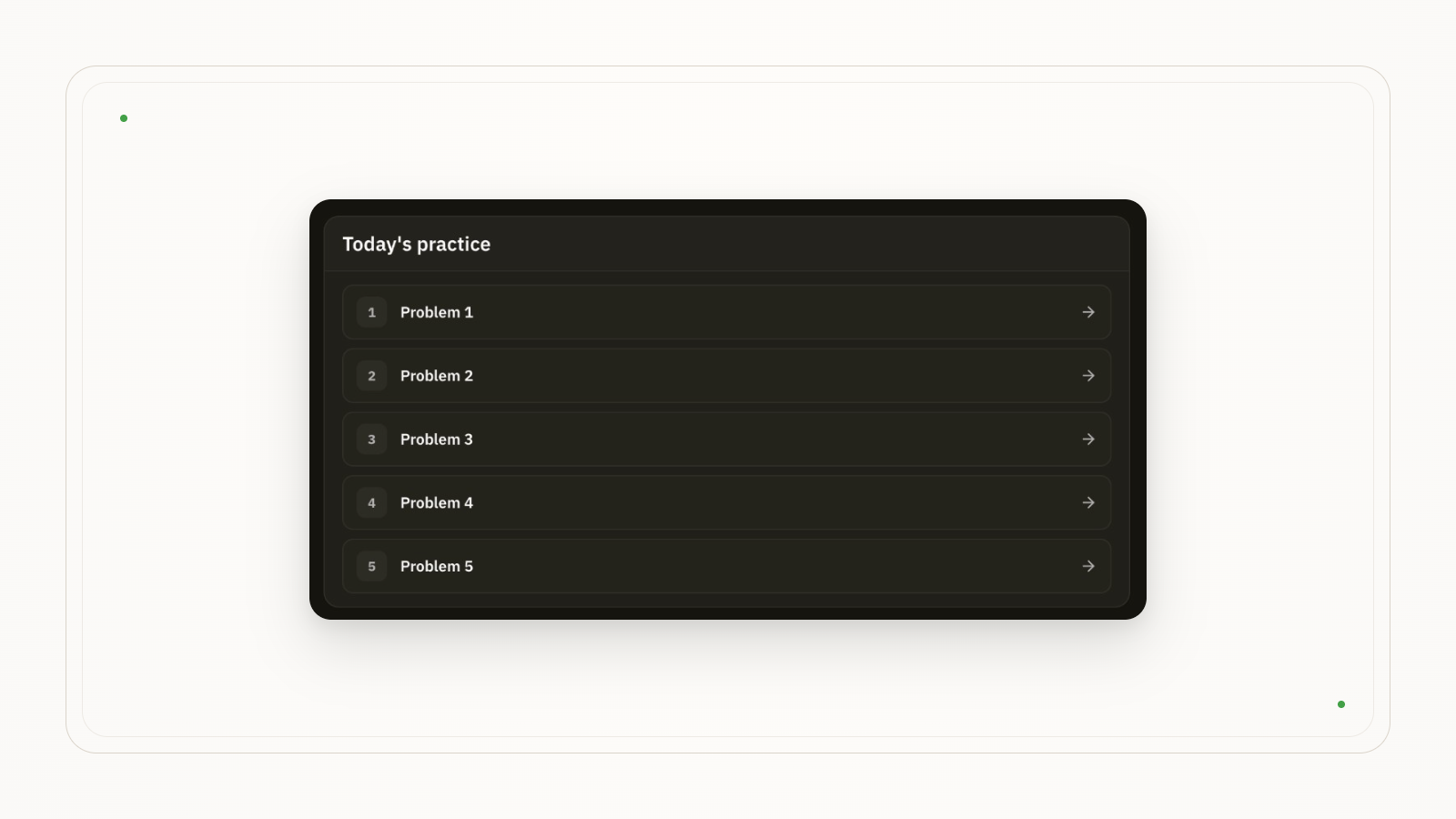
Most apps use “adaptive” to optimise engagement. We built daily practice that responds to evidence — past-paper MCQs and numeric questions, three of five to complete the quest.
When a parent asks whether our practice is "adaptive," they usually mean something specific: will the app meet my child where they are, and will it get harder when they improve?
Fair question. The word gets abused. Most products use "adaptive" to mean engagement optimisation — easier questions when frustration rises, streaks when motivation dips, synthetic drills that feel winnable because the app wants you back tomorrow.
That is not what competition students need.
In May 2026 we shipped a dashboard on problems.cc with three daily quests and an adaptive Daily 5 behind the practice quest: five past-paper problems selected for that student, that day. This is what we mean by adaptive — and what we deliberately refused to copy from the apps parents already know.
The gap most practice products miss
Most maths apps sit at two extremes:
| Extreme | What it trains | Where it fails |
|---|---|---|
| Drill apps | Fluency, speed | Almost no competition shape |
| Olympiad dumps | Deep proof work | Crushes a twelve-year-old; parents get anxious |
Competition maths sits in the middle. A child preparing for JMC, Kangaroo, or JMO Section A needs real questions at the right difficulty, with enough structure to practise on days they do not feel motivated.
We already had the logic layer — daily puzzles in February, on the App Store in mid-May. The missing piece was exam-shaped repetition: past papers, auto-graded, sequenced honestly.
Three quests, three different jobs
Every signed-in student sees three quests on the dashboard:
| Quest | Target | Job |
|---|---|---|
| Daily puzzles | Solve 1 of today's games | Logic habit — Cryptarithm, Magic Square, Summit |
| Practice | Solve 3 of 5 | Past-paper MCQ and numeric, auto-graded |
| Library path | 1 problem on a suggested lesson | Concept before drill |
The targets are deliberately soft. You do not need to clear all five practice slots to complete the quest. Three is enough to build the habit without making a bad day feel like failure.
One source of truth: the practice quest tracks the same Daily 5 shown on the dashboard card.
What adaptive means here
I want to be precise, because parents hear "adaptive AI" and picture a black box.
We do not have a model guessing your child's ability from vibes. We have a transparent selection system that uses evidence you can reason about:
- A short onboarding diagnostic — five MCQs when you first set up practice — to estimate level and difficulty ceiling
- Solve history — which topics they have faced, and whether they got them right, partially right, or wrong
- Recent wrong answers — not just "incorrect," but which topic areas keep appearing on MCQ and numeric attempts
- Their competition goal — if they are preparing for JMC 2026, problems from that paper family get a small boost
- A difficulty spread — not five identical questions; a mix from slightly below their level through a modest stretch
Tomorrow's set differs from today's because the student changed the inputs.
That is adaptive in the sense that matters for teaching: the system responds to evidence. Today's five stay fixed once generated — refreshing the page does not reshuffle mid-session. Adaptation runs overnight, not in real time while they are thinking.
Why past papers only
This was a deliberate constraint when we shipped on 22 May 2026.
Daily Practice pulls from published competition material: JMC, Grey Kangaroo, JMO Section A MCQs, numeric questions that auto-grade. MCQ and numeric only — because practice should not turn into "write a proof and wait for a human."
No library interactives in the Daily 5. No proof questions. No "write your working and hope."
Parents often ask: Why not let them practise anything?
Because practice time is scarce. If a child has fifteen minutes, I want them on a real competition question at a gradable difficulty, with feedback they can trust. The daily games handle intuition and logic. The library handles concepts. Daily Practice handles exam-shaped repetition.
What happens when they get one wrong
We added a wrong-answer pause — not a punishment, a pause.
After an incorrect MCQ or numeric attempt, the child waits about thirty seconds before trying again. They can switch to another slot in the set. The attempt is still recorded.
That matters for adaptation. A wrong answer on a divisibility MCQ does not just feel bad — it feeds the next day's selection. Topics they struggle with get prioritised. Not endlessly. Not to the point of misery. Enough that practice is not random.
The habit layer we borrowed — and what we refused
The dashboard looks like Duolingo. It is not Duolingo.
Duolingo optimises engagement. We optimise honest practice — problems from real papers, chosen for their level and weak spots, not generated drills that feel easy because the app wants another session tomorrow.
What we did keep:
- Streaks in the header — visible progress works
- Weekly standing — so serious students see where they sit among peers working consistently
- Green and amber slots — solved vs attempted but not yet solved; one tap returns to where they left off
- Carry-forward — if they did not finish an untouched set, we do not throw away the queue when the calendar rolls over
Small UX details. They matter when you are building a habit in a twelve-year-old who would rather be on YouTube.
A Tuesday set I keep thinking about
A Year 8 student, JMC in six weeks. Strong on arithmetic, wobbly on angle reasoning. Over a week she missed three MCQs that all leaned on exterior angles and parallel-line facts — not because she could not calculate, but because she did not name the relationship before picking an option.
Tuesday's Daily 5 was not five angle questions. That would have been misery. It was two geometry MCQs at manageable difficulty, one number theory she had never seen, two on-level questions from papers she was already targeting for JMC. She cleared three by dinner. Wednesday's set nudged geometry again — lighter, different paper family.
That is the shape we are aiming for: respond to evidence, keep the stretch believable.
How to use it in a school week
- One daily puzzle first — five minutes of logic before homework; same ritual we described in February.
- Three of five practice problems — enough for exam-shaped repetition; no guilt if the fifth slot waits until tomorrow.
- Library path when a topic is new — one problem on the suggested lesson before drilling it in past papers.
- Treat wrong answers as data — the pause is there so they notice; tomorrow's set will reflect it.
- Keep depth off the daily layer — full papers and curated sets stay on problems.cc; the dashboard holds the habit.
If your child does one puzzle and three past-paper questions most school days, they will improve faster than if they binge twenty problems on a Sunday and do not touch maths again for a week.
Why we built this on problems.cc
Exact Science treats preparation as a maths education lab. problems.cc is where practice lives — past papers, curated sets, daily puzzles, and now a dashboard that ties them together.
The games train logic. The library trains concepts. The adaptive Daily 5 trains competition shape.
That is the split. We copied the shell of a habit app. We refused to copy the maths inside it.
Sign in and open problems.cc/practice for today's five. Play today's puzzle at problems.cc/games — browser or App Store, same UK day either way.