
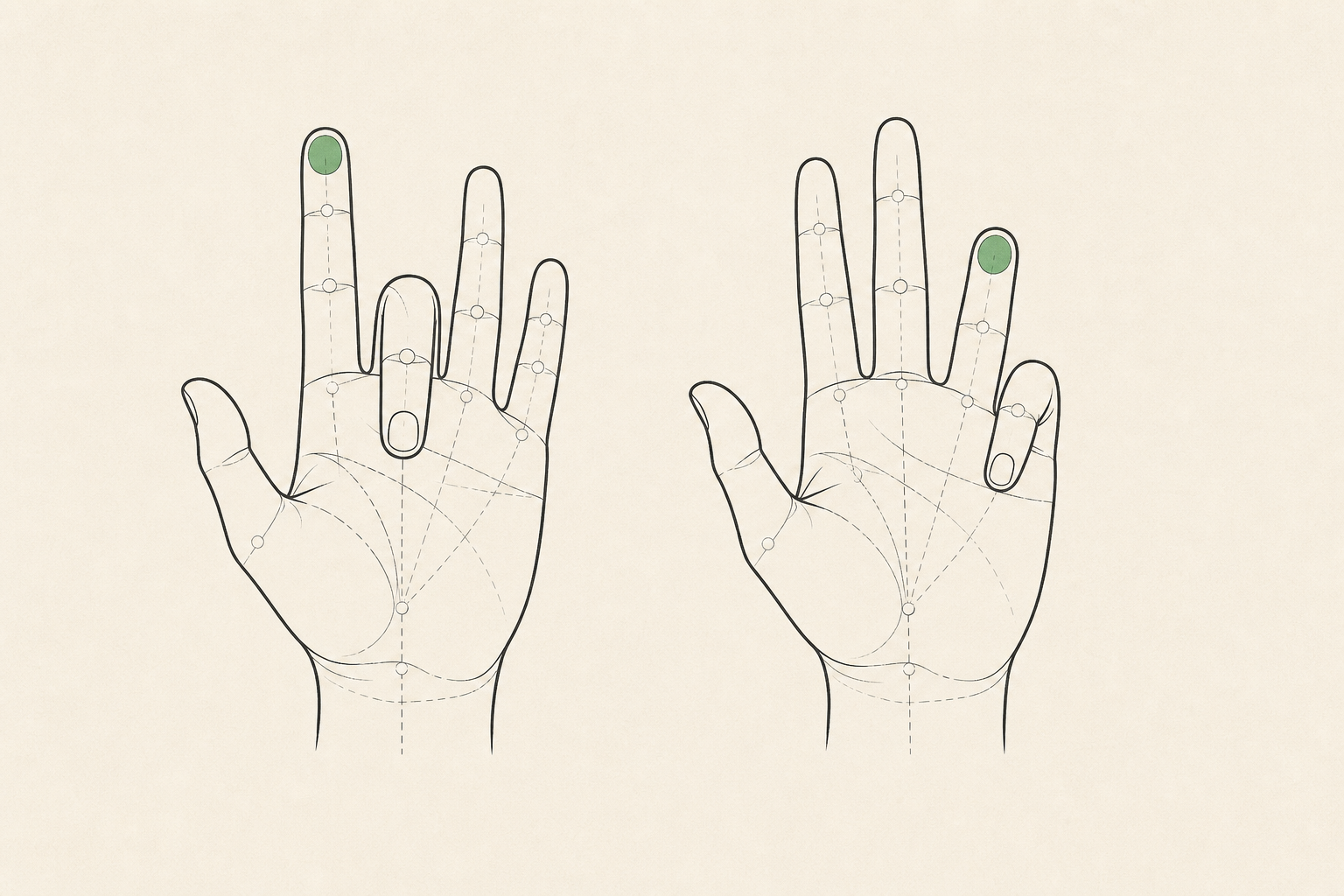
We asked how high you can count on your hands. Ten was the obvious answer — until we stopped tallying and started encoding.
In a recent group lesson I asked a question that sounded trivial.
"How high can you count using your hands?"
The immediate answer was ten.
Ten fingers. Ten numbers. Done.
We were discussing numeral systems that day, so I did not let it go. I asked: why are we assuming base 10?
Silence.
That silence is usually a good sign.
Ten fingers is not ten numbers
Everyone learns to count on their hands the same way: one, two, three, four, five, six, seven, eight, nine, ten.
That is tallying. Each raised finger adds one. Stop at ten because you run out of fingers.
But tallying is only one representation. It is not the only one.
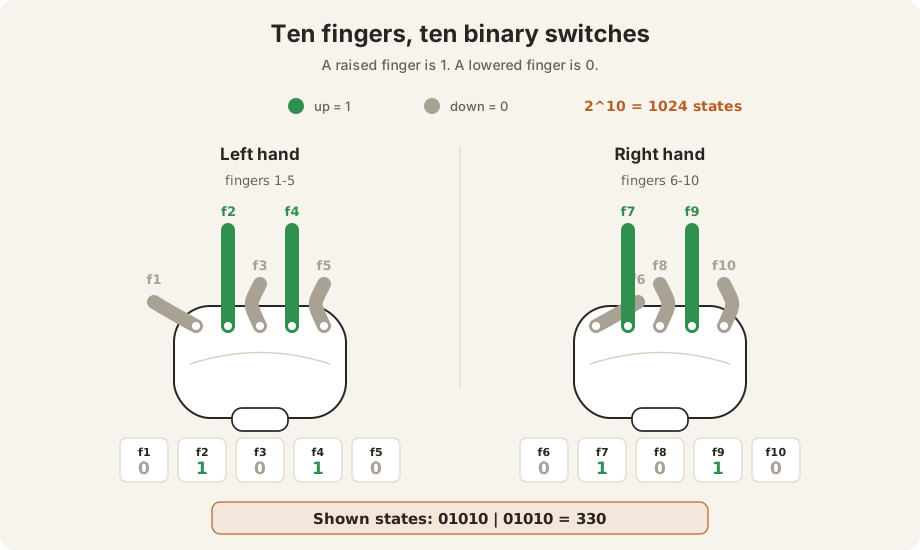
Suppose each finger is not a unit, but a switch. Up or down. Two states per finger.
Now you are not counting objects. You are encoding information.
Ten independent binary switches give:
So with perfectly ordinary hands — no extra props, no gloves — you can represent every integer from 0 to 1023.
We had not changed our hands. We had changed the interpretation.
That was the first shift in the room.
How to read the finger bits
You need a convention. We fixed one quickly:
- Left hand: thumb → little finger = bits 0 through 4
- Right hand: thumb → little finger = bits 5 through 9
- Finger up = 1, finger down = 0
With that rule, both fists is 0. All ten fingers up is 1023.
Once the convention is agreed, there is nothing to argue about. That matters. A counting system that needs a debate every time is not a counting system.
What about turning your hands around?
Then someone asked the question that opened the next layer.
"What if you turn your hands around?"
We had been thinking about fingers. But hands themselves have states.
Each hand can face the viewer palm-forward, or back-of-hand-forward. That is one extra binary choice per hand.
So now we have:
- 10 finger bits
- 2 hand-orientation bits (left palm/back, right palm/back)
Twelve independent binary decisions:
Range: 0 to 4095. We had quadrupled the space without inventing anything exotic.
The decode is clean. Let be the value from the ten finger bits (0 to 1023). Let if the left hand shows its back, if palm-forward. Let if the right hand shows its back, if palm-forward.
A student tried it immediately. Fists, both palms forward: . Same finger pattern, left hand flipped to show the back: . The room went quiet again — the good kind.
Crossing the hands
Then another student went further.
"What about crossing them?"
Crossing is not binary. You can have:
- hands apart (not crossed)
- left hand on top
- right hand on top
Three visible states. A ternary digit on top of the binary structure.
Multiply again:
That gives 0 to 12,287.
With crossing state :
At this point nobody was chasing the biggest number for its own sake. We were noticing a pattern: every time someone named another independent state, the configuration space grew multiplicatively.
I should be honest about the tradeoff. Crossing can hide fingers. A crossed pose that blocks a knuckle is fine for a thought experiment; it is slower and more error-prone if you actually want to signal 11,000 in a hurry. Combinatorics without constraints is easy. Combinatorics with readability constraints is where the real design problem lives.
A worked example
Suppose you want to signal 2500.
Work backwards from the crossing term. , so (hands not crossed).
, so try (right hand back-forward). That leaves .
, so (left palm-forward).
Now find in binary on the fingers. . Bits 2, 6, 7, 8 are on — that is left middle, right thumb, right index, right middle raised; the rest down.
Palms forward on the left, back of right hand showing, hands apart, that finger pattern: 2500. Check it on paper before you try it in the air.
The principle
If a physical system has independent states, the total number of configurations is the product of those states.
That is the engine behind positional numeral systems, digital encoding, and the exponential growth that still feels shocking even when you teach it every year.
We started with folklore: ten fingers means ten numbers.
We ended up rediscovering that mathematics grows by noticing structure, not by adding objects. We did not grow more fingers. We named more dimensions of variation — and each independent dimension multiplies the space of possibilities.
What we might try next
We briefly discussed posture: hands above the shoulders vs below, close together vs wide apart. Each clear binary choice doubles the range again. Hands high/low alone, on top of palm/back, would take you to 8192 configurations without crossing at all. We did not formalise it in the lesson. We might.
Your turn
If you have a cleaner, stranger, or more elegant hand-encoding scheme, I would genuinely like to see it.
The only rule I care about: it must be decodable without arguing. Fix the convention once, then read the number.
That constraint — combinatorics plus agreement on the alphabet — is where the fun actually starts.
If you want more questions like this in a room that takes them seriously, that is what our group lessons are for. For solo practice between sessions, problems.cc is full of non-routine problems that reward exactly this kind of reframing.