Many students think geometry means memorising angle facts and hoping they remember the right one under pressure. Our geometry camp was designed to show something much deeper.
Many students think geometry means memorising angle facts and hoping they remember the right one under pressure.
That is exactly why they never get good at it.
Geometry becomes interesting when students realise it is not mainly about shapes. It is about structure, language, and proof. That was the reason for our geometry camp. I wanted students to meet the subject properly, not as a thin school version that stops just before the mathematics becomes alive.
Why geometry is usually under-taught
School geometry often teaches enough to survive an exam question. It does not always teach enough to build control.
The missing pieces are usually the same:
- proof as something you can actually construct
- definitions used carefully rather than waved at
- constructions that force precision
- the habit of justifying each step instead of trusting a picture
That gap matters. Students who later want harder work, whether in the British Mathematical Olympiad Round 1 or simply in stronger mathematical reasoning, feel it quickly.
What we worked on in camp
We focused on the foundations many students never get to handle slowly enough:
- Euclidean plane geometry and its assumptions
- triangle congruence: SAS, ASA, SSS
- isosceles triangles, bisectors, medians, and altitudes
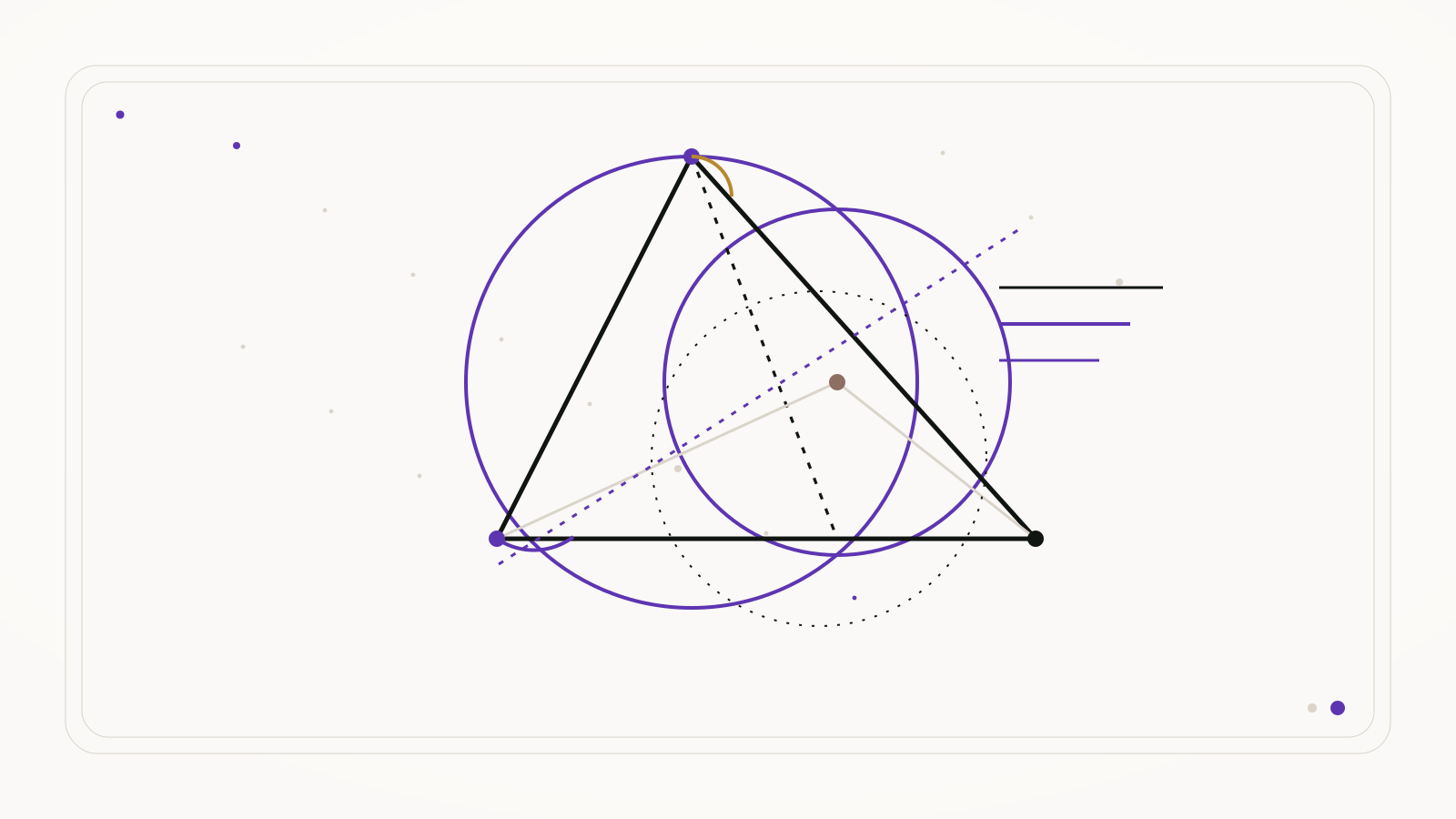
- compass-and-ruler constructions
- the triangle inequality
I like these topics because they do more than add content. They teach students what a mathematical argument feels like when it is actually holding together.
Why constructions still matter
Compass-and-ruler work is often treated as quaint. I think that is lazy.
Construction problems force students to think in dependencies. If this point is defined that way, what follows? If this line exists, what can I now claim? If the figure changes, which parts remain invariant?
That trains habits school maths often under-rewards:
- precision
- sequence
- spatial judgement
- respect for definitions
Those habits travel well.
A field note from teaching
A student who is strong at algebra can look surprisingly weak in geometry at first. Parents sometimes read that as a confidence issue. Usually it is not.
Usually the problem is that geometry punishes vague thinking earlier.
Once we slow the work down, insist on properly named objects, and ask for a reason behind each step, the same student often improves fast. I saw that repeatedly in camp. The clearer the language became, the stronger the thinking became.
Why this matters beyond one camp
Geometry is one of the best filters I know for real mathematical honesty.
A student can bluff through a lot of routine work. It is much harder to bluff through proof. Either the statement follows, or it does not. Either the diagram is carrying the logic, or the logic is carrying the diagram.
That is why geometry matters so much for competition maths. Students moving toward Olympiad-style work need exactly this kind of discipline.
If they want extra non-routine material between classes, past papers and interactive problems are a useful way to keep that habit alive.
My view
Good geometry teaching does not just produce better answers. It produces cleaner thinking.
That is the real value.